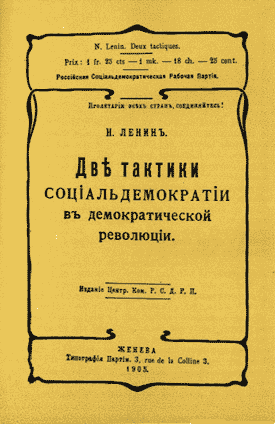
Lenin: Two Tactics of Social-Democracy in the Democratic Revolution
6From what Direction is the Proletariat Threatened with the
Danger of Having its Hands Tied in the Struggle Against the Inconsistent
Bourgeoisie?
Marxists are absolutely convinced of the bourgeois character of the
Russian revolution. What does this mean? It means that the democratic
reforms in the political system and the social and economic reforms,
which have become a necessity for Russia, do not in themselves imply the
undermining of capitalism, the undermining of bourgeois rule; on the
contrary, they will, for the first time, really clear the ground for a
wide and rapid, European, and not Asiatic, development of capitalism;
they will, for the first time, make it possible for the bourgeoisie to
rule as a class. The Socialist-Revolutionaries cannot grasp this idea,
for they are ignorant of the rudiments of the laws of development of
commodity and capitalist production; they fail to see that even the
complete success of a peasant insurrection, even the redistribution of
the whole of the land for the benefit of the peasants and in accordance
with their desires ("Black Redistribution" or something of that kind),
will not destroy capitalism at all, but will, on the contrary, give an
impetus to its development and hasten the class disintegration of the
peasantry itself. The failure to grasp this truth makes the
Socialist-Revolutionaries unconscious ideologists of the petty
bourgeoisie. Insistence on this truth is of enormous importance for
Social-Democracy, not only from the theoretical standpoint but also from
the standpoint of practical politics, for from it follows that the
complete class independence of the party of the proletariat in the
present "general democratic" movement is obligatory.
But it does not at all follow from this that a democratic revolution (bourgeois in its social and economic substance) is not of enormous
interest for the proletariat. It does not at all follow from this that
the democratic revolution cannot take place in a form advantageous
mainly to the big capitalist, the financial magnate and the
"enlightened" landlord, as well as in a form advantageous to the peasant
and to the worker.
The new-Iskraists thoroughly misunderstand the meaning and significance
of the category: bourgeois revolution. Through their arguments there
constantly runs the idea that a bourgeois revolution is a revolution
which can be advantageous only to the bourgeoisie. And yet nothing is
more erroneous than such an idea. A bourgeois revolution is a revolution
which does not go beyond the limits of the bourgeois, i.e., capitalist,
social and economic system. A bourgeois revolution expresses the need
for the development of capitalism, and far from destroying the
foundations of capitalism, it does the opposite, it broadens and deepens
them. This revolution therefore expresses the interests not only of the
working class, but of the entire bourgeoisie as well. Since the rule of
the bourgeoisie over the working class is inevitable under capitalism,
it is quite correct to say that a bourgeois revolution expresses the
interests not so much of the proletariat as of the bourgeoisie. But it
is entirely absurd to think that a bourgeois revolution does not express
the interests of the proletariat at all. This absurd idea boils down
either to the hoary Narodnik theory that a bourgeois revolution runs
counter to the interests of the proletariat, and that therefore we do
not need bourgeois political liberty; or to anarchism, which rejects all
participation of the proletariat in bourgeois politics, in a bourgeois
revolution and in bourgeois parliamentarism. From the standpoint of
theory, this idea disregards the elementary propositions of Marxism
concerning the inevitability of capitalist development where commodity
production exists. Marxism teaches that a society which is based on
commodity production, and which has commercial intercourse with
civilised capitalist nations, at a certain stage of its development,
itself, inevitably takes the road of capitalism. Marxism has irrevocably
broken with the ravings of the Narodniks and the anarchists to the
effect that Russia, for instance, can avoid capitalist development, jump
out of capitalism, or skip over it and proceed along some path other
than the path of the class struggle on the basis and within the
framework of this same capitalism.
All these principles of Marxism have been proved and explained over and
over again in minute detail in general and with regard to Russia in
particular. And from these principles it follows that the idea of
seeking salvation for the working class in anything save the further
development of capitalism is reactionary. In countries like
Russia, the working class suffers not so much from capitalism as from
the insufficient development of capitalism. The working class suffers
not so much from capitalism as from the insufficient development of
capitalism. The working class is therefore decidedly interested
in the broadest, freest and most rapid development of capitalism. The
removal of all the remnants of the old order which are hampering the
broad, free and rapid development of capitalism is of decided advantage
to the working class. The bourgeois revolution is precisely a revolution
that most resolutely sweeps away the survivals of the past, the
remnants of serfdom (which include not only autocracy but monarchy as
well) and most fully guarantees the broadest, freest and most rapid
development of capitalism.
That is why a bourgeois revolution is in the highest degree advantageous to the proletariat. A bourgeois revolution is absolutely
necessary in the interests of the proletariat. The more complete and
determined, the more consistent the bourgeois revolution, the more
assured will be the proletarian struggle against the bourgeoisie for
Socialism. Only those who are ignorant of the rudiments of scientific
Socialism can regard this conclusion as new or strange, paradoxical. And
from this conclusion, among other things, follows the thesis that, in a certain sense, a bourgeois revolution is more advantageous
to the proletariat than to the bourgeoisie. This thesis is
unquestionably correct in the following sense: it is to the advantage of
the bourgeoisie to rely on certain remnants of the past as against the
proletariat, for instance, on the monarchy, the standing army, etc. It
is to the advantage of the bourgeoisie if the bourgeois revolution does
not too resolutely sweep away all the remnants of the past, but leaves
some of them, i.e., if this revolution is not fully consistent, if it is
not complete and if it is not determined and relentless.
Social-Democrats often express this idea somewhat differently by stating
that the bourgeoisie betrays its own self, that the bourgeoisie betrays
the cause of liberty, that the bourgeoisie is incapable of being
consistently democratic. It is of greater advantage to the bourgeoisie
if the necessary changes in the direction of bourgeois democracy take
place more slowly, more gradually, more cautiously, less resolutely, by
means of reforms and not by means of revolution; if these changes spare
the "venerable" institutions of serfdom (such as the monarchy) as much
as possible; if these changes develop as little as possible the
independent revolutionary activity, initiative and energy of the common
people, i.e., the peasantry and especially the workers, for otherwise it
will be easier for the workers, as the French say, "to hitch the rifle
from one shoulder to the other," i.e., to turn against the bourgeoisie
the guns which the bourgeois revolution will place in their hands, the
liberty which the revolution will bring, the democratic institutions
which will spring up on the ground that is cleared of serfdom.
On the other hand, it is more advantageous for the working class if the
necessary changes in the direction of bourgeois democracy take place by
way of revolution and not by way of reform; for the way of reform is the
way of delay, of procrastination, of the painfully slow decomposition
of the putrid parts of the national organism. It is the proletariat and
the peasantry that suffer first of all and most of all from their
putrefaction. The revolutionary way is the way of quick amputation,
which is the least painful to the proletariat, the way of the direct
removal of the decomposing parts, the way of fewest concessions to and
least consideration for the monarchy and the disgusting, vile, rotten
and contaminating institutions which go with it.
So it is not only because of the censorship, not only "for fear of the
Jews," that our bourgeois-liberal press deplores the possibility of a
revolutionary way, is afraid of revolution, tries to frighten the tsar
with the bogey of revolution, is anxious to avoid revolution, grovels
and toadies for the sake of miserable reforms as a basis for a reformist
way. This standpoint is shared not only by the Russkiye Vedomosti, Syn
Otechestva, Nasha Zhizn and Nashi Dni, but also by the illegal,
uncensored Osvobozhdeniye. The very position the bourgeoisie
occupies as a class in capitalist society inevitably causes it to be
inconsistent in a democratic revolution. The very position the
proletariat occupies as a class compels it to be consistently
democratic. The bourgeoisie looks backward, fearing democratic progress,
which threatens to strengthen the proletariat. The proletariat has
nothing to lose but its chains, but with the aid of democracy it has the
whole world to gain. That is why the more consistent the bourgeois
revolution is in achieving its democratic changes, the less will it
limit itself to what is of advantage exclusively to the bourgeoisie. The
more consistent the bourgeois revolution, the more does it guarantee
the proletariat and the peasantry the benefits accruing from the
democratic revolution.
Marxism teaches the proletarian not to keep aloof from the bourgeois
revolution, not to be indifferent to it, not to allow the leadership of
the revolution to be assumed by the bourgeoisie but, on the contrary, to
take a most energetic part in it, to fight most resolutely for
consistent proletarian democracy, for carrying the revolution to its
conclusion. We cannot jump out of the bourgeois-democratic boundaries of
the Russian revolution, but we can vastly extend these boundaries, and
within these boundaries we can and must fight for the interests of the
proletariat, for its immediate needs and for the conditions that will
make it possible to prepare its forces for the future complete victory.
There is bourgeois democracy and bourgeois democracy. The Zemstvo
monarchist who favours an upper chamber, and who "asks" for universal
suffrage while secretly, on the sly, striking a bargain with tsarism for
a curtailed constitution, is also a bourgeois-democrat. And the peasant
who is fighting, arms in hand, against the landlords and the government
officials and with a "naïve republicanism" proposes "to send the tsar
packing"[14], is
also a bourgeois-democrat. There are bourgeois-democratic regimes like
the one in Germany and also in England, like the one in Austria and also
like those in America or Switzerland. He would be a fine Marxist
indeed, who in a period of democratic revolution failed to see the
difference between the degrees of democracy, the difference of its
various forms and confined himself to "clever" remarks to the effect
that, after all, this is "a bourgeois revolution," the fruits of a
"bourgeois revolution."
Our new-Iskraists are just such clever fellows flaunting their
shortsightedness. They confine themselves to disquisitions on the
bourgeois character of the revolution just when and where it is
necessary to be able to draw a distinction between
republican-revolutionary and monarchist-liberal bourgeois democracy, to
say nothing of the distinction between inconsistent bourgeois
democratism and consistent proletarian democratism. They are
satisfied—as if they had really become like the "man in the muffler"[18]—to converse dolefully about a "process of mutual struggle of antagonistic classes," when the question is one of giving democratic leadership in the present revolution, of emphasising progressive democratic
slogans as distinguished from the treacherous slogans of Mr. Struve and
Co., of bluntly and straight forwardly stating the immediate aims of
the really revolutionary struggle of the proletariat and the peasantry,
as distinguished from the liberal haggling of the landlords and factory
owners. Such now is the gist of the matter, which you, gentlemen, have
missed: will our revolution result in a real, immense victory, or merely
in a wretched deal, will it go so far as the revolutionary-democratic
dictatorship of the proletariat and the peasantry, or will it "peter
out" in a liberal constitution à la Shipov?
At first sight it may appear that in raising this question we are
deviating entirely from our subject. But this may appear to be so only
at first sight. As a matter of fact, it is precisely this question that
lies at the root of the difference in principle which has already become
clearly marked between the Social-Democratic tactics of the Third
Congress of the Russian Social-Democratic Labour Party and the tactics
initiated by the Conference of the new Iskra supporters. The
latter have already taken not two but three steps back, resurrecting the
mistakes of Economism in solving problems that are incomparably more
complex, more important and more vital to the workers' party, viz.,
questions of its tactics in time of revolution. That is why we must
analyse the question we have raised with all due attention.
The above-quoted section of the new-Iskraists resolution which we have
quoted above points to the danger of Social-Democracy tying its hands in
the struggle against the inconsistent policy of the bourgeoisie, of its
becoming dissolved in bourgeois democracy. The idea of this danger runs
like a thread through all the literature typical of the new Iskra,
it is the real pivot of the principle involved in our Party split (ever
since the elements of squabbling in this split were wholly eclipsed by
the elements of a turn towards Economism). And without any equivocation
we admit that this danger really exists, that just at the present time,
at the height of the Russian revolution, this danger has become
particularly grave. The pressing and extremely responsible duty that
devolves on all of us theoreticians or—as I should prefer to say of
myself— publicists of Social-Democracy, is to find out from what direction
this danger actually threatens. For the source of our disagreement is
not a dispute as to whether such a danger exists, but the dispute as to
whether it is caused by the so-called khvostism of the "Minority" or the so-called revolutionism of the "Majority."
To remove all misinterpretations and misunderstandings, let us first of
all note that the danger to which we are referring lies not in the
subjective, but in the objective aspect of the matter, not in the formal
position which Social-Democracy will take in the struggle, but in the
material outcome of the entire present revolutionary struggle. The
question is not whether this or that Social-Democratic group will want
to dissolve in bourgeois democracy or whether they are conscious of the
fact that they are merging. Nobody suggests that. We do not suspect any
Social-Democrat of harbouring such a desire, and this is not at all a
question of desires. Nor is it a question of whether this or that
Social-Democratic group will formally retain its separate identity,
individuality and independence of bourgeois democracy throughout the
course of the revolution. They may not only proclaim such "independence"
but even retain it formally, and yet it may turn out that
their hands will nonetheless be tied in the struggle against the
inconsistency of the bourgeoisie. The final political result of the
revolution may prove to be that, in spite of the formal "independence"
of Social-Democracy, in spite of its complete organisational
individuality as a separate party, it will in fact not be independent,
it will not be able to put the imprint of its proletarian independence
on the course of events, will prove so weak that, on the whole and in
the last analysis, its "dissolving" in the bourgeois democracy will
nonetheless be a historical fact.
That is what constitutes the real danger. Now let us see from what
direction the danger threatens: from the fact that Social-Democracy as
represented by the new Iskra is deviating to the Right—as we believe; or from the fact that Social-Democracy as represented by the "Majority," the Vperyod, etc., is deviating to the Left—as the new-Iskraists believe.
The answer to this question, as we have pointed out, depends on the
objective combination of the actions of the various social forces. The
character of these forces has been defined theoretically by the Marxian
analysis of Russian life; at the present time it is being defined in
practice by the open action of groups and classes in the course of the
revolution. Thus, the entire theoretical analysis made by the Marxists
long before the period we are now passing through, as well as all the
practical observations of the development of revolutionary events, show
that from the standpoint of objective conditions there are two possible
courses and outcomes of the revolution in Russia. A change in the
economic and political system in Russia along bourgeois-democratic lines
is inevitable and unavoidable. No power on earth can prevent such a
change. But the combined actions of the existing forces which are
effecting that change may result in one of two things, may bring about
one of two forms of that change. Either 1) the result will be a
"decisive victory of the revolution over tsarism," or 2) the forces will
be inadequate for a decisive victory and the matter will end in a deal
between tsarism and the most "inconsistent" and most "self-seeking"
elements of the bourgeoisie. By and large all the infinite variety of
detail and combinations, which no one is able to foresee, lead to one or
the other.
Let us now consider these two outcomes, first, from the standpoint of
their social significance and, secondly, from the standpoint of the
position of Social-Democracy (its "dissolving" or "having its hands
tied") in one or the other case.
What is a "decisive victory of the revolution over tsarism"? We have
already seen that in using this expression the new-Iskraists fail to
grasp even its immediate political significance. Still less do they seem
to understand the class essence of this concept. Surely, we Marxists
must not under any circumstances allow ourselves to be deluded by words
such as "revolution" or "the great Russian revolution," as do many
revolutionary democrats (of the Gapon type). We must be perfectly clear
in our minds as to what real social forces are opposed to "tsarism"
(which is a real force, perfectly intelligible to all) and are capable
of gaining a "decisive victory" over it. Such a force cannot be the big
bourgeoisie, the landlords, the factory owners, "society" which follows
the lead of the Osvobozhdentsi. We see that these do not even
want a decisive victory. We know that owing to their class position they
are incapable of waging a decisive struggle against tsarism; they are
too heavily fettered by private property, capital and land to enter into
a decisive struggle. They need tsarism with its bureaucratic, police
and military forces for use against the proletariat and the peasantry
too much to be able to strive for its destruction. No, the only force
capable of gaining "a decisive victory over tsarism," is the people,
i.e., the proletariat and the peasantry, if we take the main, big forces
and distribute the rural and urban petty bourgeoisie (also part of "the
people") between the two. "A decisive victory of the revolution over
tsarism" is the revolutionary-democratic dictatorship of the proletariat and the peasantry. Our new-Iskraists cannot escape from this conclusion, which Vperyod pointed out long ago. No one else is capable of gaining a decisive victory over tsarism.
And such a victory will be precisely a dictatorship, i.e., it must
inevitably rely on military force, on the arming of the masses, on an
insurrection, and not on institutions of one kind or another,
established in a "lawful" or "peaceful" way. It can be only a
dictatorship, for the realisation of the changes which are urgently and
absolutely indispensable for the proletariat and the peasantry will call
forth the desperate resistance of the landlords, of the big bourgeoisie
and of tsarism. Without a dictatorship it is impossible to break down
that resistance and to repel the counter-revolutionary attempts. But of
course it will be a democratic, not a socialist dictatorship. It will
not be able (without a series of intermediary stages of revolutionary
development) to affect the foundations of capitalism. At best it may
bring about a radical redistribution of landed property in favour of the
peasantry, establish consistent and full democracy including the
formation of a republic, eradicate all the oppressive features of
Asiatic bondage, not only in village but also in factory life, lay the
foundation for a thorough improvement in the position of the workers and
for a rise in their standard of living, and—last but not least—carry
the revolutionary conflagration into Europe. Such a victory will by no
means as yet transform our bourgeois revolution into a socialist
revolution; the democratic revolution will not directly overstep the
bounds of bourgeois social and economic relationships; nevertheless, the
significance of such a victory for the future development of Russia and
of the whole world will be immense. Nothing will raise the
revolutionary energy of the world proletariat so much, nothing will
shorten the path leading to its complete victory to such an extent, as
this decisive victory of the revolution that has now started in Russia.
How far such a victory is probable, is another question. We are not in
the least inclined to be unreasonably optimistic on that score, we do
not for a moment forget the immense difficulties of this task, but since
we are out to fight we must desire victory and be able to point out the
right road to it. Tendencies capable of leading to such a victory
undoubtedly exist. True, our, Social-Democratic, influence on the masses
of the proletariat is as yet very, very inadequate; the revolutionary
influence on the mass of the peasantry is altogether insignificant; the
proletariat, and especially the peasantry, are still frightfully
scattered, backward and ignorant. But revolution unites quickly and
enlightens quickly. Every step in its development rouses the masses and
attracts them with irresistible force to the side of the revolutionary
program, as the only program that fully and consistently expresses their
real and vital interests.
According to a law of mechanics, every action produces an equal
reaction. In history also the destructive force of a revolution is to a
considerable degree dependent on how strong and protracted the
suppression of the striving for liberty had been, and how profound the
contradiction between the antediluvian "superstructure" and the living
forces of the present epoch. The international political situation, too,
is in many respects shaping itself in a way most advantageous for the
Russian revolution. The insurrection of the workers and peasants has
already commenced; it is sporadic, spontaneous, weak, but it
unquestionably and undoubtedly proves the existence of forces capable of
waging a decisive struggle and marching towards a decisive victory.
If these forces prove inadequate, tsarism will have time to conclude the
deal which is already being prepared on two sides, by Messrs. the
Bulygins on the one side, and Messrs. the Struves, on the other. Then
the whole thing will end in a curtailed constitution, or, if the worst
comes to the worst, even in a travesty of a constitution. This will also
be a "bourgeois revolution," but it will be a miscarriage, a premature
birth, a mongrel. Social-Democracy entertains no illusions on that
score, it knows the treacherous nature of the bourgeoisie, it will not
lose heart or abandon its persistent, patient, sustained work of giving
the proletariat class training even in the most drab, humdrum days of
bourgeois-constitutional, "Shipov" bliss. Such an outcome would be more
or less similar to the outcome of almost all the democratic revolutions
in Europe during the nineteenth century, and our Party development would
then proceed along the difficult, hard, long, but familiar and beaten
track.
The question now arises: in which of these two possible outcomes will
Social-Democracy find its hands actually tied in the fight against the
inconsistent and self-seeking bourgeoisie, find itself actually
"dissolved," or almost so, in bourgeois democracy?
It is sufficient to put this question clearly to have not a moment's difficulty in answering it.
If the bourgeoisie succeeds in frustrating the Russian revolution by
coming to terms with tsarism, Social-Democracy will find its hands
actually tied in the fight against the inconsistent bourgeoisie;
Social-Democracy will find itself dissolved "in bourgeois democracy" in
the sense that the proletariat will not succeed in putting its clear
imprint on the revolution, will not succeed in settling accounts with
tsarism in the proletarian or, as Marx once said, "in the plebeian" way.
If the revolution gains a decisive victory—then we shall settle accounts
with tsarism in the Jacobin, or, if you like, in the plebeian way. "The
whole French terrorism," wrote Marx in 1848 in the famous Neue Rheinische Zeitung,
"was nothing but a plebeian manner of settling accounts with the
enemies of the bourgeoisie, with absolutism, feudalism and philistinism"
(see Marx, Nachlass, Mehring's edition, Volume III, p. 211)[19].
Have those people who, in a period of a democratic revolution, try to
frighten the Social-Democratic workers in Russia with the bogey of
"Jacobinism" ever stopped to think of the significance of these words of
Marx?
The Girondists of contemporary Russian Social-Democracy, the new Iskra-ists, do not merge with the Osvobozhdentsi, but in point of fact they, by reason of the nature of their slogans, follow at the tail of the latter. And the Osvobozhdentsi,
i.e., the representatives of the liberal bourgeoisie, wish to settle
accounts with the autocracy gently, in a reformist way, in a yielding
manner, so as not to offend the aristocracy, the nobles, the
Court—cautiously, without breaking anything—kindly and politely, as
befits gentlemen in white gloves (like the ones Mr. Petrunkevich
borrowed from a bashi-bazouk to wear at the reception of
"representatives of the people"[?] held by Nicholas the Bloody[15]. See Proletary, No. 5)[16].
The Jacobins of contemporary Social-Democracy—the Bolsheviks, the Vperyodovtsi, Syezdovtsi, Proletartsi (e.g. supporters of the Vperyod, the "Congress" group, or supporters of Proletary) — all names given to the Bolsheviks, derived from their publication of the two papers mentioned, and "Syezdovtsi"
because they convened the Third Congress of the R.S.D.L.P. or whatever
we may call them—wish by their slogans to raise the revolutionary and
republican petty bourgeoisie, and especially the peasantry, to the level
of the consistent democratism of the proletariat, which fully retains
its individuality as a class. They want the people, i.e., the
proletariat and the peasantry, to settle accounts with the monarchy and
the aristocracy in the "plebeian way," ruthlessly destroying the enemies
of liberty, crushing their resistance by force, making no concessions
whatever to the accursed heritage of serfdom, of Asiatic barbarism and
human degradation.
This, of course, does not mean that we necessarily propose to imitate
the Jacobins of 1793, to adopt their views, program, slogans and methods
of action. Nothing of the kind. Our program is not an old one, it is a
new one—the minimum program of the Russian Social-Democratic Labour
Party. We have a new slogan: the revolutionary-democratic dictatorship
of the proletariat and the peasantry. We shall also have, if we live to
see a real victory of the revolution, new methods of action, in harmony
with the nature and aims of the working-class party that is striving for
a complete socialist revolution. By our comparison we merely want to
explain that the representatives of the progressive class of the
twentieth century, of the proletariat, i.e., the Social-Democrats, are
divided into two wings (the opportunist and the revolutionary) similar
to those into which the representatives of the progressive class of the
eighteenth century, the bourgeoisie, were divided, i.e., the Girondists
and the Jacobins.
Only in the event of a complete victory of the democratic revolution
will the proletariat have its hands free in the struggle against the
inconsistent bourgeoisie, only in that event will it not become
"dissolved" in bourgeois democracy, but will leave its proletarian or
rather proletarian-peasant imprint on the whole revolution.
In a word, in order to avoid finding itself with its hands tied in the
struggle against the inconsistent bourgeois democrats, the proletariat
must be sufficiently class conscious and strong to rouse the peasantry
to revolutionary consciousness, to direct its attack, and thereby to
pursue the line of consistent proletarian democratism independently.
This is how matters stand with regard to the question, so ineptly dealt with by the new Iskragroup,
of the danger of our hands being tied in the struggle against the
inconsistent bourgeoisie. The bourgeoisie will always be inconsistent.
There is nothing more naïve and futile than attempts to set forth
conditions and points[17],
which if satisfied, would enable us to consider that the bourgeois
democrat is a sincere friend of the people. Only the proletariat can be a
consistent fighter for democracy. It may become a victorious fighter
for democracy only if the peasant masses join its revolutionary
struggle. If the proletariat is not strong enough for this, the
bourgeoisie will be at the head of the democratic revolution and will
impart to it an inconsistent and self-seeking nature. Nothing short of a
revolutionary-democratic dictatorship of the proletariat and the
peasantry can prevent this.
Thus, we arrive at the indubitable conclusion that it is precisely the new Iskra tactics, by its objective significance, that are playing into the hands of the bourgeois democrats.
Preaching organisational diffusion that goes to the length of
plebiscites, the principle of compromise and the divorcement of Party
literature from the Party, belittling the aims of armed insurrection,
confusing the popular political slogans of the revolutionary proletariat
with those of the monarchist bourgeoisie, distorting the requisites for
a "decisive victory of the revolution over tsarism"—all this taken
together constitutes that very policy of khvostism in a
revolutionary period which perplexes the proletariat, disorganises it,
confuses its understanding and belittles the tactics of
Social-Democracy, instead of pointing out the only way to victory and of
rallying all the revolutionary and republican elements of the people to
the proletariat's slogan.
* * *
To bear out this conclusion, reached by us through analysis of the
resolution, let us approach this same question from other angles. Let us
see, first, how in the Georgian Sotsial-Demokrat a naïve and outspoken Menshevik illustrates the new-Iskra. Secondly, let us see who is actually making use of the new Iskra slogans in the present political situation.
[14]
See the Osvobozbdeniye, No. 71, page 337, footnote 2. —Lenin
[15]
A reference to the audience granted to the Zemstvo deputation by
Nicholas II on June 6, 1905. The deputation handed in a petition with
the request to convene representatives of the people in order to
establish a "renewed constitution". The petition contained neither the
demand for universal, direct and equal suffrage by secret ballot, nor
the demand for guaranteed free elections. —Lenin
[16]
"'Revolutionaries' in Kid Gloves", 1905. See present edition. Volume 8, pp. 526-30.-Ed.—Lenin
[17]
As was attempted by Starover in his resolution, annulled by the Third
Congress[20↓], and as is attempted by the Conference in an equally bad
resolution. —Lenin
[18]
The man in the muffler-the chief character in Chekhov's story
of the same name, a man typifying the narrow-minded philistine who
abhors all innovations or initiative.
[19]
Lenin is referring to the book Aus demm literarische,. Nachlass von Karl Marx, Friedrich Engels und Ferdinand Lassalle. Heraus gegeben von Franz Mshring, Bd. III, Stuttgart 1902, S. 211. See K. Marx and F. Engels, Selected Works, Moscow 1958, Vol. I, P. 67
[20]
The reference is to the resolution tabled by Starover (pseudonym of the
Menshevik A. N. Potresov) on the attitude towards the liberals, which
was adopted at the Second Congress of the R.S.D.L.P., and was criticised
by Lenin in the article "Working-Class and Bourgeois Democracy" (see
present edition, Vol. 8, pp. 72-82).
|